Celebrating a successful pilot
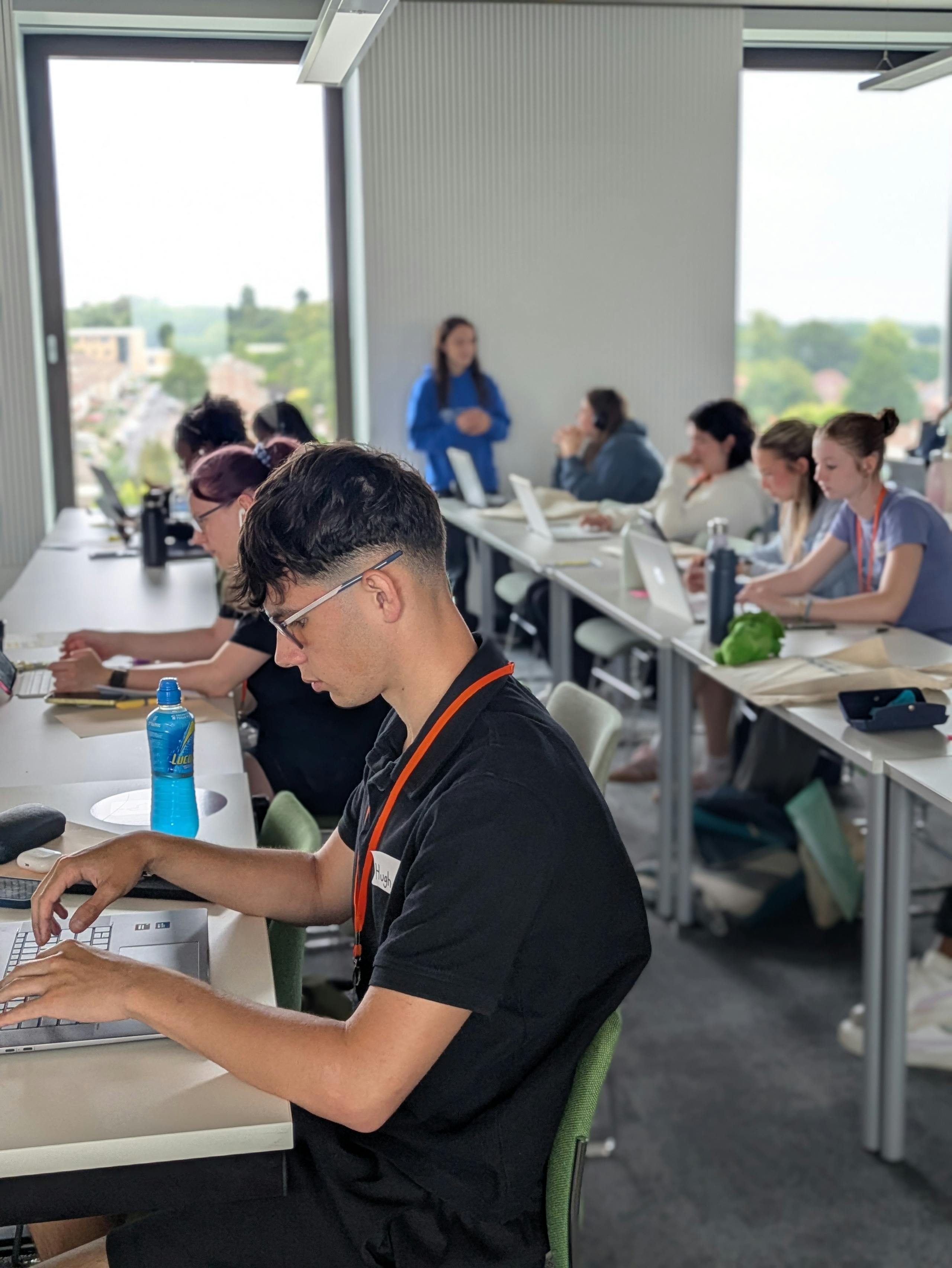
Held on our Highfield Campus in Southampton, the first ever EPQ Writing Retreat welcomed 12 students from schools and colleges across the region. Participants engaged in a full day of writing blocks, academic skills workshops, a student finance session, and a campus tour. The event was shaped by the popular and evidence-informed practice of writing retreats in academia but adapted for a new audience of 16-19-year-old students.
Feedback was overwhelmingly positive:
- 92% of attendees agreed the retreat helped them make progress with their EPQ.
- 92% said they were glad they attended.
Students also reported tangible academic gains, such as completing key sections of their projects and learning new writing strategies like freewriting and time-blocking. One student told us: “I learned how I'm supposed to write my EPQ, and I managed to figure out what I'm actually doing!! (It's not confusing anymore!)”
The EPQ: A powerful tool for HE transition
The EPQ is more than just a qualification - it’s a bridge to higher education (HE) success. Research shows that students who complete an EPQ are:
- 22% more likely to progress to HE;
- 50% less likely to drop out in their first or second year;
- 6 to 8% more likely to achieve a 1st or 2:1 degree.
These benefits are even more pronounced for students from disadvantaged backgrounds.
By supporting EPQ completion and attainment, we can help close the gap in HE access, continuation, and success. At the University of Southampton, the Learn with US Transition team are doing pioneering work to raise attainment via the EPQ, by supporting the academic skills development of EPQ students from low-participation postcodes and those who have received Free School Meals (groups traditionally underrepresented in higher education (HE)).
Similarly, the retreat was targeted at students who may face additional barriers to accessing HE, and aimed to:
- Raise EPQ attainment through academic skills support;
- Increase students’ sense that they could “belong” in HE;
- Improve students’ understanding of university life.
Taken together, we hoped these outcomes would in turn increase rates of continuation to HE for the students who attended. Indeed, while the short duration of the event limited measurable changes in belonging, qualitative feedback suggested increased confidence and a more informed view of university study. Importantly, the retreat provided a supportive academic environment: a key factor in fostering belonging and motivation among students from underrepresented groups.
How can I apply these principles in my own setting?
Writing retreats for your EPQ students, can offer a scalable, impactful way to provide additional academic support, especially for students who may not have access to this kind of structured writing time or support elsewhere. Even a single day of focused writing, supported by expert input and peer encouragement, can make a significant difference. If you are interested in running your own EPQ writing retreat, check out our DIY writing retreat toolkit for some inspiration, or get in touch with the team: learnwithus@soton.ac.uk.
What else can I do?
We know that EPQ coordinators in schools and colleges are doing incredible work, often with limited time and resources. If you don’t have capacity to run a full-day retreat, you could:
- Seek out collaboration opportunities with local universities or other FE providers;
- Facilitate the creation of peer-led writing groups;
- Offer virtual writing power-hours with guided prompts and check-ins – check out this article from Rosie Wadman and Jess Macpherson.
Looking ahead
We’re proud of what this pilot achieved, and we’re excited to build on it. If you’re interested in collaborating, replicating this model, or simply learning more, we’d love to hear from you. You can connect with our team via email: learnwithus@soton.ac.uk